
What Is The Pelvic Floor?
The pelvic floor is composed of a thin sheet of muscle fibers and associated connective tissue which spans the area underneath the pelvis between the pubic bone at the front and the sacrum or tailbone at the back (see illustration below).
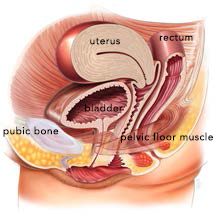
What Do The Pelvic Floor Muscles Do?
When you cough, sneeze, or strain, the pelvic floor muscles tighten, which helps to avoid unintentional urine leaks. They aid in the support of the organs in your belly, particularly when you are standing. They aid in the protection of the pelvic organs from external injury. They aid in the proper positioning of pelvic organs such as the bladder. They aid in the regulation of the passage of urine, gas, and bowel movements. During intercourse, they have a role in sexual function.
In order for the pelvic floor muscles to carry out their function well, they need to be fit and adequately toned just like any other muscle in the body.
What If My Pelvic Floor Muscles Are Weak?
A weakness of the pelvic floor muscles may cause or worsen a number of problems including:
- Stress urinary incontinence – the complaint of involuntary loss of urine on effort or physical exertion, including sporting activities etc., or on sneezing or coughing.
- Urge urinary incontinence – the complaint of involuntary loss of urine associated with a sudden urgent need to pass urine.
- Mixed urgency and stress incontinence – the complaint of involuntary loss of urine associated with urgency and with effort or physical exertion, or on sneezing or coughing.
- Pelvic Organ Prolapse – leading to a bulging of the bladder, bowel, or uterus (womb) into the vagina or out of the vaginal entrance if more severe.
- A loss in sexual sensation or feeling of vaginal looseness.
What Causes Pelvic Floor Muscle Weakness?
- Under use. Like all muscles, the pelvic floor muscles need exercise to work well. Regular and adequate intensive exercise of the pelvic floor muscles should be maintained all through life (not just after having children) and is therefore very important.
- Damage to the muscles during pregnancy and childbirth.
- The change in hormones associated with menopause might play a role in weakening the muscles but is still debatable.
- Decreased muscle tone with aging.
- Damage to the muscles through long-term straining when constipated or associated with a chronic cough or obesity.
The Role Of Pelvic Floor Exercises
Intensive and regular pelvic floor exercises help by both strengthening and relaxing the pelvic floor muscles, so they become firm and supportive, but not overactive. Many women will have a major improvement in or recovery from symptoms of stress urinary incontinence by learning effective pelvic floor exercises, thus avoiding or delaying the need for surgery.
How To Exercise Your Pelvic Floor Muscles
It is important to learn to do the exercises in the right way, and to check from time to time that you are still doing them correctly. Your therapist can help you to understand this by using diagrams, drawings and models.
- In the upright position, sit comfortably with your feet and knees wide apart. If preferred, you can also lie down flat (supine position) with your legs slightly apart. Remember to keep breathing throughout and keep your stomach, leg and buttock muscles relaxed.
- Imagine that you are trying to stop yourself from passing gas from the bowel and at the same time trying to stop the flow of urine from the bladder. You should feel a lifting and tightening around the vagina and anus.
- Observing the muscles can be an effective way of checking they are working correctly. Lie propped on the bed; place a small mirror between your legs with your knees bent and apart. As you pull up the pelvic floor you should see your anus and entrance to the vagina lifting and drawing in.
Note: If you notice the entrance to the vagina widening, you are pushing down and not pulling up, which is the opposite to tightening the pelvic floor muscle. Also, if you leak urine or pass gas when doing the exercises, it is likely you are pushing down not pulling up.
You may not be able to immediately contract and relax adequately at first. Don’t be disappointed. Most patients will learn to contract and relax if they are given some time by themselves at home to practice.
How Often Should I Practice?
First determine your ‘starting block’. Use your diary.
Tighten your pelvic floor muscles maximally without using your buttocks or thigh muscles as described above. Hold tight for as many seconds as you can (up to a maximum of 10 seconds).
How long can you hold the maximal contraction?
_____ seconds (e.g. 2 seconds)
Release the contraction and rest for at least the same time of the contraction. Repeat the ‘tighten, hold and release’ as many times as you can (up to a maximum of 8-12 repetitions).
How many times can you repeat the contraction?
_____times (e.g. 4 times)
This becomes your ‘starting block.’ Repeat your starting block 4-6 times during the day. As a result of this muscle training, your pelvic floor will get stronger and your starting block will change, e.g. 4 secs, 6 times. This becomes your new starting block.
This program builds up the endurance of the muscle group. In other words, the muscle will be able to work harder for longer. Now perform the pelvic floor exercise but squeeze quickly and then let go. Rest 1-2 seconds before the next one. These are called quick contractions and will help your muscles react quickly when you laugh, cough, exercise or lift.
How Many Contractions Can You Do?
Aim to increase this number to 8-12 contractions, 3 times a day for at least 6 months. That’s the easy bit; the most difficult part of the program is remembering to do the exercises! Here are some tips to help trigger your memory:
- Wear your watch on the wrong wrist.
- Put stickers in places that will catch your eye (e.g. bathroom mirror, telephone, fridge, kettle, steering wheel).
- Exercise after you have emptied your bladder.
- Exercise in any position.
How Quickly Will I See Results?
You may not feel your bladder control improve until after 3-6 weeks, but it may take up to 6 months to have improvement. DON’T GIVE UP!! It is important to maintain the strength of the muscles once you have completed an exercise program. Practicing your exercises twice a week, 3 sets of 8-12 maximal contractions, 3 times a day should be sufficient. Try to incorporate these exercises into daily life activities. If you are not sure that you are doing the exercises correctly, ask your family doctor, nurse, physiotherapist or continence nurse to check for you.
What If I Can’t Contract My Pelvic Floor Muscles?
If you are unable to contract your muscles, your health professional may suggest some additional treatments.
- Biofeedback. This aims to help women identify and selectively contract and relax the pelvic floor muscles using signals from their own bodies. Feeling the muscles with your fingers is one example of this. Other methods involve using small sticky electrodes placed on the abdomen and buttock area or an intra-vaginal or intrarectal probe connected to a computer. The strength and length of the contraction you perform can then be seen on the computer screen.
- Electrical Stimulation Therapy. Sometimes the pelvic floor muscles cannot (yet) contract due to nerve damage, e.g. from the delivery of a baby or after surgery. Electrical stimulation will provide an artificial contraction of the pelvic floor muscles, thus helping to strengthen them. This method is not suitable for women who can already contract their pelvic floor muscles even if those contractions are weak. There are a number of great devices which can enhance your kegel training if you don’t have time for physical therapy. This article from New York Magazine discusses the best kegel exercisers. Estim devices can help tighten the pelvic floor in women who have a hard time coordinating their kegel exercises.
- https://www.amazon.com/K-fit-Kegel-Toner-Women-Exerciser/dp/B011SQPZGS/ref=pd_lpo_2?pd_rd_i=B011SQPZGS&psc=1
- https://www.amazon.com/Exerciser-Incontinence-Stimulator-Bladder-Exercise/dp/B07R2K4Z1Z
- https://www.amazon.com/Yarlap-AutoKegel-Technology-Effortless-Strengthening/dp/B01N7K06HW/ref=sr_1_4?crid=3VOSD1ZGYNDR6&keywords=yarlap+kegel+stimulator+for+women&qid=1657417960&s=hpc&sprefix=yarlap%2Chpc%2C157&sr=1-4
Points To Remember
- Weak pelvic muscles often cause bladder control problems.
- Daily intensive exercises can strengthen pelvic muscles and improve bladder control
- Ask your therapist whether you are squeezing the right muscles.
- Always tighten and contract your pelvic muscles before coughing, sneezing, jumping or lifting to help prevent involuntary loss of urine, gas or stool, or bulging down of your pelvic organs.
- Try to maintain your weight within healthy limits.
For more information, visit YourPelvicFloor.org.
Information derived from a IUGA pdf: www.yourpelvicfloor.org/conditions/pelvic-floor-exercises/